Showing posts with label trouble. Show all posts

Sunday, 11 February 2018

When life gives you lemons - make lemon curd.


A good friend, many years ago, used to refer to James 1:2 - 4: " Consider it a sheer gift, friends, when tests and challenges come at you from all sides. You know that under pressure, your faith-life is forced into the open and shows its true colors. So don’t try to get out of anything prematurely. Let it do its work so you become mature and well-developed, not deficient in any way." My friend, a diminutive blond Dane, would ask, smiling hugely: "So, when the elephant of Circumstances sits on you, what do you produce: sour lemon juice, or sweet orange juice?"

Sweet orange juice was, of course, the preferred answer, the one we all aim for. To be sweet and faithful and loving in spite of desperate circumstances. To bring light and joy. Nothing sour about us, please.

Yet lemons are a truly wonderful fruit. Their strong, tangy scent is, in my opinion, far superior to their more insipid cousins, the plain oranges. I could wax lyrical about the many uses and benefits of lemons, but today, it is lemon curd I want to focus on.

When life gives you lemons, make lemon curd.

Lemon curd* - a delicious preserve made from lemons, sugar, eggs and  butter - makes everything better. I make lemon curd when:
  • I feel a little down or discouraged, needing a lift to my spirits.
  • I feel the need to be creative in some way - a good way of relaxing
  • I want to give a friend a little gift: a tiny jar of lemon curd is always gratefully received.
  • I have lemons in the fridge begging to be used up.
  • I crave a little sweetness.
Making lemon curd gives me so much and teaches me so many things. I learn to appreciate that:

Injury can release a sweet fragrance into the atmosphere. Today, I grated the rind before I went out to church, leaving the rind and lemons sitting on the counter. On my return, the whole house smelt deliciously of a subtle citrus fragrance. The wounded skin released its scent into the air, permeating every room.

As I gently rasped the skin against the harsh grater, I  thought of how wounds, willingly given to God, are offered up to him as a pleasing sacrifice. The lemon couldn't but help release a delicate, fresh aroma: I longed to be as gentle and generous when circumstances grate on or trouble me.

Creating is a slow process. The making of lemon curd cannot be hurried. Heat the mixture too fast, and the egg will cook on its own, resulting in pieces of egg white marring the consistency. 

Circumstances can change rapidly. Stirring has to be rapid,vigorous, watchful, so that nothing spills over and the mixture does not stick. 

Cooking requires a degree of concentration and watchfulness. Look away for a moment, and the mixture may curdle or boil over. 

Making lemon curd encourages calm. As I stir the curd, giving it my full attention, I feel my spirit calm and quiet down. I focus on the pan, stirring gently, swirling the mixture first this way, then that; round and round, first clockwise, then in the contrary direction. Sometimes I draw figure of eight in the surface with the whisk.  Sometimes, I just stir. And stir. I contemplate. I wait. 

The final product may not be smooth and trouble-free. When I make lemon curd, I like to keep the rind in to give it extra tangyness to counteract the sweetness. The resultant curd may have bits of rind or pulp. It reminds me that even when God works powerfully to bring about good, there may still be - there WILL be - lumps and bumps, but life is sweet, flavoursome and far more precious than a jar of delicious lemon preserves.

I make lemon curd. I lose stress and hurry. I grow patience. I receive peace.

When life gives you lemons, receive them as a gift. Make lemon curd.


*Lemon curd recipe: makes approximately two 340g jars.
Grate the rind of 3 large lemons (or 2 large lemons and 1 small orange) and squeeze the juice.
Add to a small pan with 2 ounces of butter, 3 large eggs and a cup (or slightly less) of white sugar.
Add an extra squeeze of lemon juice from a bottle - about 2 tablespoons.
Stir, with a wire whisk, constantly over medium heat until the mixture starts to thicken. Do not boil.
Pour into sterilized jars, cover, and keep in the fridge.

Sunday, 15 February 2015

Trouble

Wonderful post from Devotionals Daily, from Sheila Walsh. Reposting here for reference - for the day I will need to be kickstarted into remembering God's promises in the day of trouble.

        
You keep track of all my sorrows.You have collected all my tears in Your bottle.You have recorded each one in Your book. - Psalm 56:8
Devotionals Daily

The Sacred Ache: No Tear Forgotten
by Sheila Walsh, God Loves Broken People
Meet Sheila Walsh
In the midst of our pain and grief—and especially at the front end—we may imagine God has abandoned us, forgotten us, dismissed us, or simply ignored us. We’re not the first occupants of this broken planet to feel this way, nor will we be the last. Even a quick stroll through the Psalms reveals how often human thoughts wander down this shadowy pathway:

  • “My soul is in anguish. How long, O Lord, how long?” (Psalm 6:3).
  • “How long, O Lord? Will You forget me forever? How long will You hide Your face from me? How long must I wrestle with my thoughts and every day have sorrow in my heart? How long will my enemy triumph over me?” (Psalm 13:1–2).
  • “How long, O Lord? Will You hide yourself forever? How long will Your wrath burn like fire? Remember how fleeting is my life. For what futility You have created all men!” (Psalm 89:46–47).
  • “Relent, O Lord! How long will it be? Have compassion on Your servants. Satisfy us in the morning with Your unfailing love, that we may sing for joy and be glad all our days. Make us glad for as many days as You have afflicted us, for as many years as we have seen trouble” (Psalm 90:13–15).
The prophet Habakkuk got in the act, too, crying out,

How long, O Lord, must I call for help, but You do not listen? - Habakkuk 1:2

That’s how we feel, and God seems to have no problem with our expressing it. So when you cry out to the Lord, asking Him your own version of “How long?” recognize that you’re in good company.

But please don’t leave it there. Don’t allow your ache to remain merely an ache. Remember the truth, and allow that truth to seep into your troubled mind so that your ache might begin its transformation into something sacred. Remember what David whispered to God, after yet another near-death escape?

You keep track of all my sorrows.

You have collected all my tears in Your bottle.

You have recorded each one in Your book. - Psalm 56:8

Why would He do that? Why would God keep track of all our sorrows? Why would He collect all our tears in a bottle? Why does the Lord record each heartache, each grief, each sadness in some divine journal inscribed with heavenly ink?

It’s because He has plans for those things.

It’s because He wastes nothing.

He intends to fill our sorrows and tears with His expansive love. This was the glorious expectation of both the prophets and the apostles when each said of God:

He will swallow up death forever; and the Lord God will wipe away tears from all faces. - Isaiah 25:8

He will wipe every tear from their eyes. There will be no more death or mourning or crying or pain, for the old order of things has passed away. - Revelation 21:4

When we remember this — when we recall that God does in fact notice our pain, that He collects each tear in a bottle so that one day He might replace each teardrop with an ocean of divine love — our souls stop shrinking and begin to expand. The small world of our pain gives way to something boundless... beyond measure... beyond our reckoning.

God’s incomprehensible love.

This is the biblical truth. This is the Christian’s hope. And this is the sacred ache.
Psalm 56:8
Excerpted with permission from God Loves Broken People (And Those Who Pretend They're Not) by Sheila Walsh, copyright Thomas Nelson.


Move from feeling terminally hopeless into the arms of the One who brings hope and healing....

Join us as Sheila Walsh candidly shares the harrowing story of how she quickly spiraled from co-hosting the 700 Club into a psychiatric ward and the extraordinary journey back from the brink of debilitating depression and anxiety.
Get practical, real, and hopeful help as Sheila shares how the truth which she .thought would kill her, actually saved her life

God Loves Broken People                            
The Other Side of Brokenness 

If I could write only one book in my  lifetime, I would ask God to make it this one, the very book you now hold in your hands....―Sheila Walsh

God loves broken people. And when weary, wounded men and women find a way to open their bruised hearts and somehow welcome Him into their personal darkness, they will find a love beyond anything they have ever known.

When the glass house Sheila had lived in for so many years came crashing to the ground, she began a new life outside the safety of those walls. No, it didn't feel good, nor safe―not at all. But it felt true. Sheila saw herself as a broken lamb limping after the Shepherd, not knowing where He was going, but knowing that wherever He went, she wanted to go with Him.

In twelve stirring, insightful, and deeply revealing chapters, Sheila Walsh shows how personal brokenness can open doors of intimacy with Jesus Christ that might never open in any other way.

It's not that God loves broken people more than those who imagine themselves to be whole―it's simply that they know they are loved. They dare to believe it . . . and through such trust, a new wholeness emerges from yesterday's broken pieces.
Learn more about God Loves Broken People....


Thursday, 26 December 2013

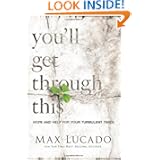
You'll Get Through This: Hope and Help for Your Turbulent Times by Max Lucado

I am reviewing this for Booksneeze, which generously gave me a free copy for my Kindle. I'm in the middle of turbulent times as it is, but this is a book I have already reread and will do so again.

In his typical fashion, Max Lucado writes with grace and truth, combining words and phrases with such elegance that wisdom seeps out through them almost unnoticed. His message is simple: you’ll get through this. It won’t be painless. It won’t be quick. But God will use this mess for good...With God’s help you will get through this.


The book is based on Joseph’s life – with encouragement from other Bible stories thrown in for good measure. Max Lucado reminds us of eternal truths: that, whatever else is taken from us: health, wealth, relationships...we cannot lose our destiny as loved children of an almighty God.

Neither should we try to escape from God, recognising that God can use our difficulties to test our faith and train us, like children. Patience can be learned through waiting; an attitude of gratitude gets us through the hard stuff. We CAN rely on God.

Lucado tackles those difficult questions: is God good, even when life isn't? How can I find healing? Where can I find forgiveness in me?Can I ever forgive...? How can I deal with the death of a loved one?

Each chapter in itself could have been a book. There are, as we discover near the end of this book, no easy answers. Max Lucado offers a little encouragement along the way: not to give up hope. The book is an effortless read because the style is so easy, but it is not undemanding. Some phrases, some chapters will annoy you. Stop there, and consider why. Use the discussion questions at the back. Pray. Pause. Reflect. Let God speak truth into your life through these little challenges: stay with Him, and find help and healing along the way.
I review for BookSneeze®
Product Details

Friday, 16 September 2011

Choosing joy...

I've been reminded to 'intentionally choose joy' by Ayla recently. And have heard myself saying that happiness is a choice...yet it's hard, sometimes, to actually do that.
Lysa Terkeust has some words of wisdom to help with that: when we ask:
'Why did this happen?  Why didn’t You stop this God?  Why weren’t my prayers answered?
Have you ever been there? Have you ever had a big situation in your life where you just couldn’t process why God would allow this to happen? Or maybe even a small annoyance like losing your keys or having a flat tire on a morning you really needed to be somewhere.

It’s so tempting to wallow in the why.
Asking why is perfectly normal. Asking why isn’t unspiritual. However, if asking why pushes us farther from God rather than drawing us closer to Him, it is the wrong question.
If asking why doesn’t offer hope, what will?
The what question.
In other words: “Now that this is my reality, what am I supposed to do with it?”
I like to call this verse “directions on where to park my mind.”
Philippians 4:8, “Finally brothers, whatever is true, whatever is noble, whatever is right, whatever is pure, whatever is lovely, whatever is admirable—if anything is excellent or praiseworthy—think about such things.” (NIV)
Instead of wallowing...say:
This is my reality, now what am I going to do with it?
What can I learn from this?
What part of this is for my protection?
What other opportunities could God be providing?
What maturity could God be building into me?
Switching from the why to the what question paves the road to parking our mind in a much better place.
Is it always easy? Nope.
But is it a way to find a perspective beyond situations where we feel God has allowed something in our lives we don’t understand and we absolutely don’t like? Yes.
I pray this helps you today. You can also download a free resource on how to change your why questions into what questions. Just go to my blog, www.LysaTerKeurst.com and click on the button “When God Hurts Your Feelings.”